Too Many AI Tools? Your AI Stack Is a Trap
By Dustin W. Stout · · 14 min read
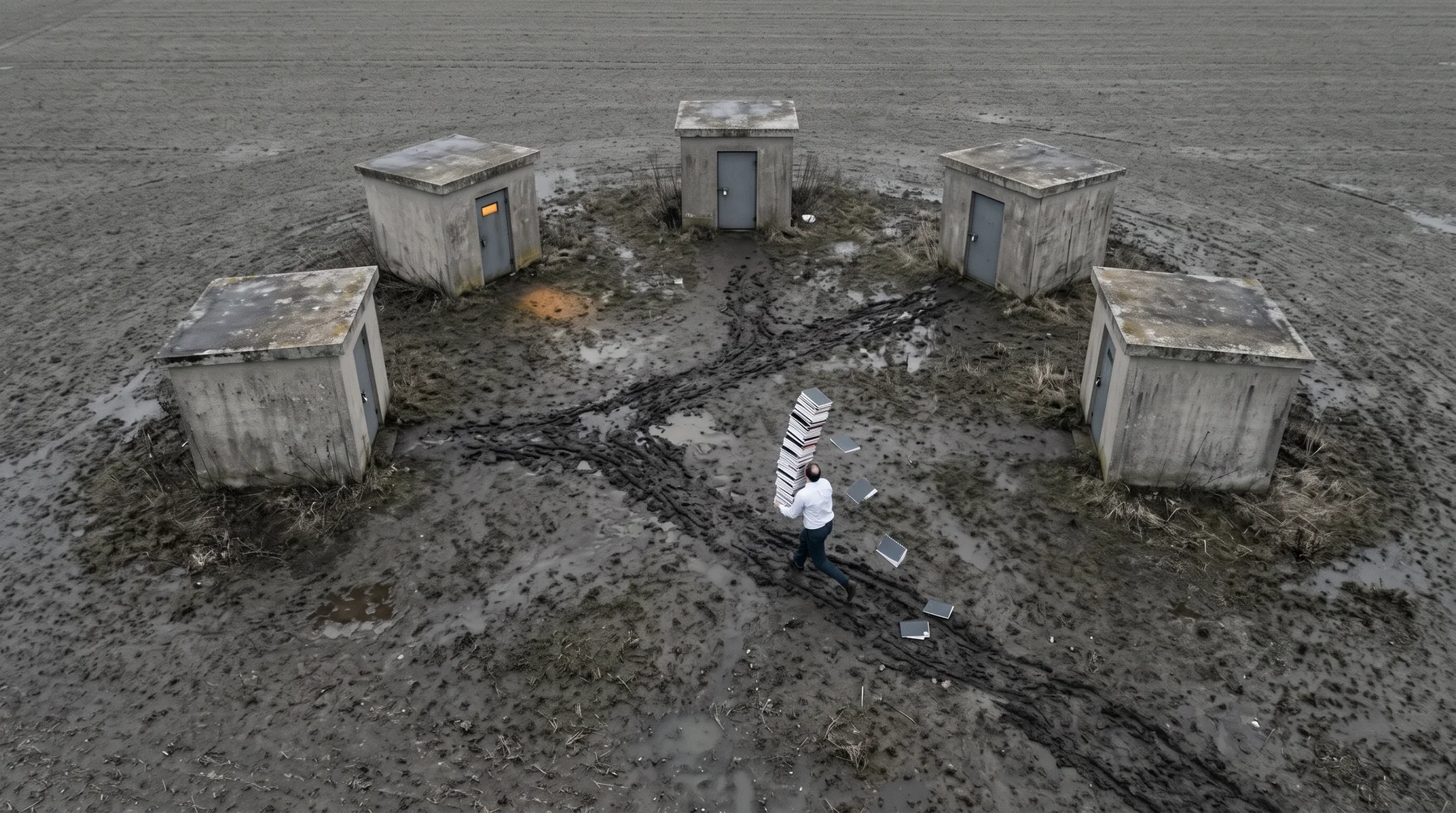
Your AI stack is a trap. And you don't even realize you're tangled up in it.
Too many AI tools split your work into pieces that never build on each other, and one shared workspace is the fix.
Every app keeps its own memory, so you re-explain yourself every time you switch.
Not an accident. A design.
Every week, a new app. New model. New tab. New "you have to try this."
Come over here. No, over here.
Each one wants you living inside its walls. Its memory. Its tools. Its silo. Nobody builds a bridge to the competition, because the walls are the business model.
So you bounce. ChatGPT for writing. Claude for thinking. Another app for images. Another for video.
You call that picking the best tool for every job.
I call it being split into pieces.
I'm the founder of Magai, so weigh this accordingly. But if you've ever looked at Magai and your first thought was "that's the cheap way to get all of them," you missed the point completely.
The rest of this post is what you missed.
Five geniuses in five locked buildings is how most people use AI
Say you hire five geniuses. A writer. A designer. A video editor. An analyst. A strategist.
Now put each one in a different building. Locked doors. Separate notebooks. No shared memory.
Every project, you run between the buildings.
You give the strategist the goal and she hands you a plan. You carry a summary of that plan to the writer, who has never heard of your business.
You describe the brand to the designer from scratch. Then you explain all of it again to the video editor, who gets the shortest version because you're tired by now.
Each of them is brilliant. None of them can build on what the others made.
You're the only thing connecting them. And you're a terrible filing cabinet.
Swap the geniuses for software and you have your week. The writer is a chat model in one tab. The designer is an image app in another. The editor is a video tool in a third, and the strategist is a second chat model you open when you need to think.
Each one is excellent at its job. Each one starts every project knowing nothing about you.
Take an ordinary Tuesday. You settle the positioning for a new workshop in one chat. It's a good position, because you spent an hour arguing the reasons out with the model.
Then you open a second app to write the landing page, and you paste in the conclusion.
What you can't paste is the argument. The model writing the page never saw the angles you rejected, or why. So it cheerfully writes one of them.
Then you open an image app and describe your brand colors. Then a video app, and you describe them again.
What travels between the buildings is a summary you typed from memory. The reasoning, the rejected options, the tone you settled on and the file you uploaded an hour ago all stay behind the locked door.

That's the whole problem. Each genius in this story gets smarter every quarter. The doors stay locked.
Why do AI apps keep your context locked inside?
Because of how the products are built. Each AI app stores what it learns about you inside that app, and a product that holds your context is a product you keep opening. No company has a reason to build a bridge to a rival.
OpenAI's help page on ChatGPT memory lists what ChatGPT can draw on, depending on your plan and region. That includes past chats, saved memories, custom instructions, files in Library and content from connected apps such as Gmail.
That's a sensible design for ChatGPT. It also means that memory belongs to ChatGPT.
Pay for five assistants and you own five memories. What you tell one, the others never hear. Moving your context across is a manual job, and you're the one doing it.
Images and video work the same way. A chat app built by one company tends to hand work to that company's own tools. It has little reason to hand your brief to a rival's.
So the strategist can't pass the plan to a designer who works somewhere else. You carry it, through the clipboard.
Almost everyone is building this stack alone. In Microsoft and LinkedIn's 2024 Work Trend Index, 78% of AI users said they bring their own AI tools to work.
That's a lot of people assembling their own stacks, one tool at a time, with nobody connecting the pieces.
I've complained about AI tool overload before, mostly at the influencers pushing fifty tools at once. This is the deeper problem. Even a tidy stack of five can't share what it learns.
The tools are strong. The only connection between them is you.
What do too many AI tools actually cost you?
Too many AI tools cost you hours before they cost you money. Researchers have measured what bouncing between apps does to a workday, though not with chatbots specifically.
A 2022 Harvard Business Review analysis of 20 teams found that workers toggled between apps and websites about 1,200 times a day. They spent almost four hours a week reorienting after the switches.
Gloria Mark, an information scientist at UC Irvine, has found that people take around 23 minutes on average to resume an interrupted task. A Microsoft Research paper she co-authored cites the number.
Neither study is about AI. Both describe what happens when your attention changes buildings.
An AI switch costs more than a tab switch. You find your place in a document by scrolling. You can't scroll up to an argument you had in another app. You rebuild it in writing, for something that has never met you.
That's the hidden bill for five subscriptions. It never shows up on a card statement.
It shows up as the second hour of a project that should have taken one. It shows up as work that comes back generic, because the model never had the context to make it specific.
You can measure your own cost without any tools. For three working days, keep a note open. Every time you re-explain your brand, your audience, your goal or a past decision to an AI, add a tick. Add them up on Friday.
Don't estimate the time. Count the ticks. That number is how much of your week you spend as the bridge between buildings.

One room beats five buildings because every tool reads the same notes
Put all five geniuses in one room. Same whiteboard. Same files. Same memory.
The writer hears what the strategist said. The designer sees the draft. The editor knows the brand. Nobody starts from zero, because the work is already on the wall.
That's the idea behind Magai. Magai is my company, and I built it to tear the walls down.
It's one workspace with dozens of top models in it. You can switch models in the middle of a conversation and the thread doesn't forget anything. The model changes. What it knows doesn't.
Four pieces make the room work. Each one removes a trip between buildings:
- Memory keeps facts, dates and preferences across models and chats, so you say it once and every model knows it.
- Agents are reusable custom instructions you write once. Every model you pick starts from them.
- Images, video and audio live in the same workspace as chat, so the brief never passes through your clipboard.
- Integrations connect your agents to the apps where your work lives, like Gmail and Google Drive.
Put those together and you get the line I'd put on the wall of every AI team.
One memory across every model.
One workspace across every modality.
One source of truth.
Side by side, the difference is what survives the move from one step to the next:
| What you need at each step | Five separate apps | One workspace |
|---|---|---|
| Your brand and goals | Re-explained in every app | Written once in an agent that runs on any model |
| What one model learned | Stays inside that app | Shared across models and chats |
| Switching to a different model | New chat and a pasted summary | Same thread, context intact |
| Text to image or video | Copy the brief into another app | Same workspace, same thread |
| Your connected tools | Connected again in each app | Connected to your agents |
| Where finished work lives | Scattered across five histories | One place, in folders and collections |
Plenty of products put many models behind one login. The test that matters is whether context survives the switch mid-thread. I explained how to check in what an AI aggregator is.
If your first thought was "cheaper," you missed what you're buying
Calling Magai a discount is like seeing a team and thinking, "I save on rent." You'd be right about the rent. You'd have missed what a team is for.
I run Magai, so weigh this section accordingly. The argument holds whether you trust me or not, and you can check every piece of it.
Yes, the arithmetic can look good. It's the least interesting number in this post. The pricing page shows what each plan includes.
The savings are a side effect, and for some people they don't exist. If you build with AI every day, you may spend the same on Magai as you do now. Maybe more. Daily building burns capacity, so you buy capacity.
That's fine.
Even at the same price, the setup is stronger, because every tool works from the same memory.
A bigger bill for a team that works together beats a smaller bill for five that never meet. I've said it before: stop counting AI pennies. The price of the tool matters far less than what your hours are worth.
Now the objection you're already forming. "I'll just use the best tool for each job."
You can. You should. Picking the right model for the task is correct, and I've argued that which model to choose is the wrong question to start with. In Magai you keep doing it, because the same top models sit in one picker.
What changes is where those models live while you work.
Where they live decides whether the work builds. The best tool per job across five apps gives you five good drafts and no shared understanding. The best tool per job in one workspace gives you a thread where the strategist's reasoning is still on the wall when the designer starts.
Whoever is passing you has the same models
Whoever is pulling ahead of you probably has the same models and a similar budget. The difference is where their work lives.
Every chat in a shared workspace leaves something behind. A decision. A preference. A file. A finished draft. The next chat starts from there, and the one after starts from both.
That's compounding.
Five apps can't compound, because each pile is private. You can build a pile in every app and feel productive. A year later you have five piles and one tired person acting as the index.
This hits AI harder than ordinary software. A spreadsheet doesn't need to know you to add up a column. A model needs to know you to sound like you.
So if a competitor works from one shared memory and you work from five private ones, they get faster every month. You stay where you are.
Not talent. Not budget. Architecture.
One launch, run both ways, shows where the hours go
Run the same launch across five apps and across one workspace, and the difference is how many times you brief a tool. The steps below illustrate the mechanics. They're not a test, so use your own tally for real numbers.
Say you're launching a paid workshop. You need positioning, landing page copy, a second opinion on that copy, a hero image, a short teaser clip and an announcement email.
| Step | Five apps | One workspace |
|---|---|---|
| Positioning | Argue it out in one chat, and the reasoning stays there | Argue it out in a thread with an agent that already knows your offer and voice |
| Landing page copy | Open a second app, paste the conclusion, explain the audience again | Switch models in the same thread and the argument comes with you |
| Second opinion | Paste the draft into a third app and hope the critique knows the goal | Ask another model in the same thread, with the goal still in front of it |
| Hero image | Open an image app and describe your brand from scratch | Ask in the same thread |
| Teaser clip | Another app, another description of the brand | Same thread again |
| Announcement email | Copy the final copy into your email tool | With Gmail connected to your agent, draft it from the same thread |
Count the briefings. In the left column you briefed five tools. In the right you briefed once, in the agent, and everything after that inherited it.
You can run this in Magai, my company, today:
- Create an agent with your offer, your audience, your brand voice and the rules you'd give a new hire.
- Open a chat with that agent and start with positioning, using whichever model you like best for thinking.
- When the task changes, change the model. The thread comes with you.
- Ask for the hero image and the teaser in the same thread.
- Save the thread in a folder for the launch.
Next month, the next launch starts from that folder instead of from zero.
Two things go wrong the first time.
The first is a bloated briefing. People paste in the whole brand book and bury the handful of rules that matter. Brief the agent the way you'd brief a sharp new hire in their first hour, and keep the long reference files beside it.
The second is trusting the first answer from any one model. When two models in the same thread disagree, that's the room doing its job. Ask a third to referee against the goals already in the thread.

A source of truth works because you write it yourself
A source of truth is the place your work is written down: your brand, your offer, your past decisions. When every model reads it, they agree. When five models each read their own scraps, they contradict each other and you referee.
Notice the word "write." I've been blunt about automatic AI memory. A pile of everything you ever said to a chatbot is not a source of truth, and it can bend your work in ways you can't see.
The wall that works is one you chose on purpose. A useful one holds five things:
- Your offer in two sentences, written the way you'd say it to a customer.
- Your audience, with the problem they'd name in their own words.
- Your voice, including the phrases you'd never use.
- Decisions you've already made, with the reasons and the options you rejected.
- The files of record, such as price lists, brand guidelines and past work you're proud of.
The reasons matter as much as the decisions. A model that knows you rejected an angle won't offer it back three weeks later.
A wall needs upkeep. Once a quarter, read it top to bottom and delete what's stale. The offer you changed. The audience you outgrew. The decision you reversed.
A source of truth with two contradicting notes is worse than none, because every model picks a side at random.
When a model gives you something that sounds off, check the wall first. Models follow what they're given.
When one app is enough
If your whole day lives inside one app, stay there. The argument stops being true when nothing gets handed off.
Say you work almost entirely inside one suite, such as Gmail and Docs with Gemini, or Microsoft 365 with Copilot. The walls aren't in your way. The same holds for a coding assistant that lives in your editor all day.
Nothing gets passed anywhere, so nothing gets lost.
The trouble starts when a project crosses the boundary. The research happens in one app, the draft in the suite, the image somewhere else. At that point you're not choosing between one AI and five. You're choosing whether the handoffs happen by hand or in one place.
Sprawl starts at two apps. A chat model plus a separate image app. A research tool plus a drafting tool.
Check once a month whether a second tool has crept in. It rarely arrives as a decision. It arrives as a link a colleague sent you.
Teams feel the same effect at a larger size. When everyone works from the same notes, a new hire's first draft starts where the founder's does. I keep the rest of my thinking on tools in the Artificial Intelligence archive.
Run the one-week test before you decide anything
A claim like this is worth nothing until it holds up against your own work. Test it for one week, against the tally from earlier:
- Count your baseline. Over three working days, tick every time you re-explain your brand, your audience or a past decision to an AI.
- Write the briefing once. Create an agent in Magai, my company, with your offer, audience, voice and the rules you'd give a new hire.
- Pick one real project with a deadline. Choose something that touches at least two kinds of work, like copy and an image.
- Run the whole project in one thread. Switch models when the task changes.
- Count the ticks again on a similar project.
- Keep the thread. The next project starts by pointing at it.
Read the result honestly. If the ticks fell by half or more, the sprawl was real and you've found the fix. If they barely moved, your work was never spread across apps, and you belong in the one-app group.
Either answer is worth a week.
Quality counts too. Put the finished piece next to your usual output from five apps. Does it sound more like you? If it does, the model had the wall to read.

Your geniuses are already brilliant.
Stop running between buildings. Put them in one room.